d-fine
Consultant at d-fine s.r.l. (Milan)
Quantitative consulting
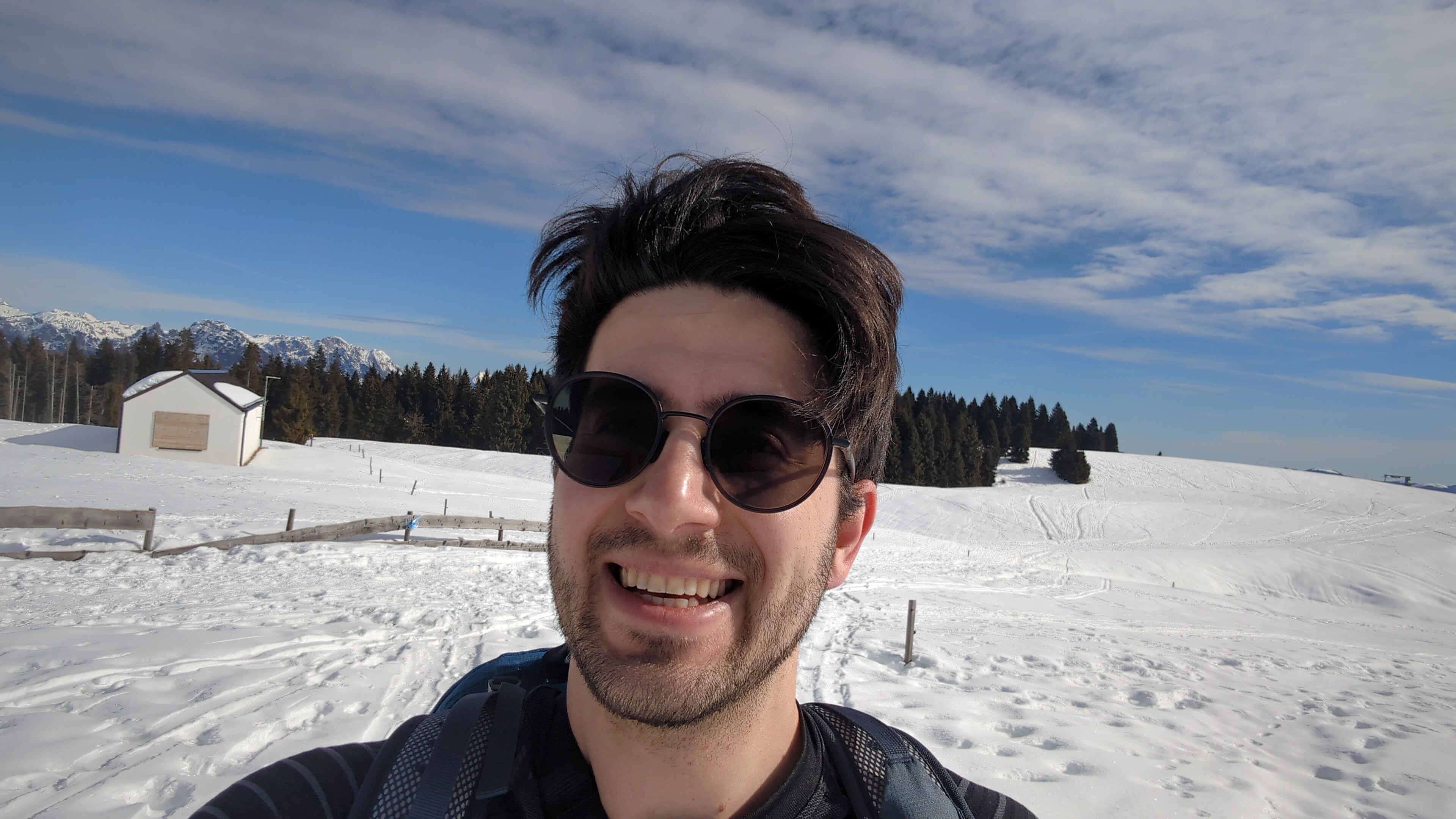
Hello! I'm Francesco, and you've just landed on my personal website. 😁 I'm a physicist who loves to solve complex problems by combining multiple methods, merging mathematics, programming, and statistics. Here you can find information about me and the projects I'm working on. If you have any questions or would like to collaborate, feel free to contact me!
Currently, Consultant at d-fine s.r.l. · Milan
01 The through-line
Francesco Slongo studied physics at the University of Trento, spending his third year abroad on a 10-month Erasmus exchange at the University of Oslo. He went on to a master's in theoretical physics in the joint Trento–SISSA programme, and then a PhD at SISSA in Trieste, under the supervision of Cristian Micheletti.
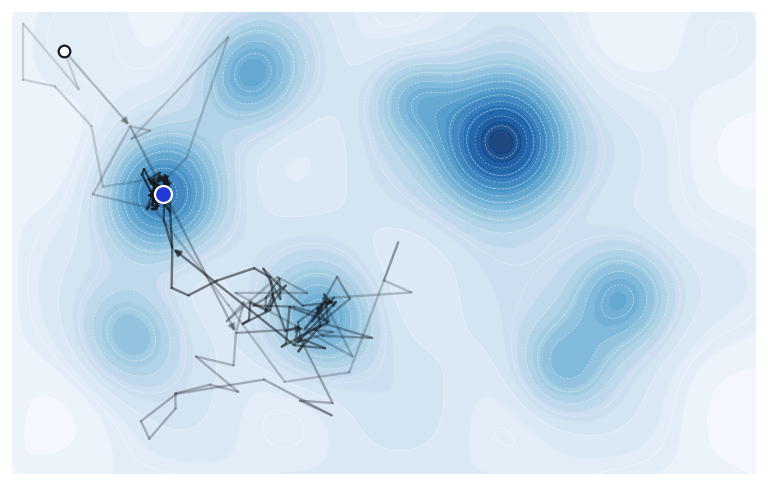
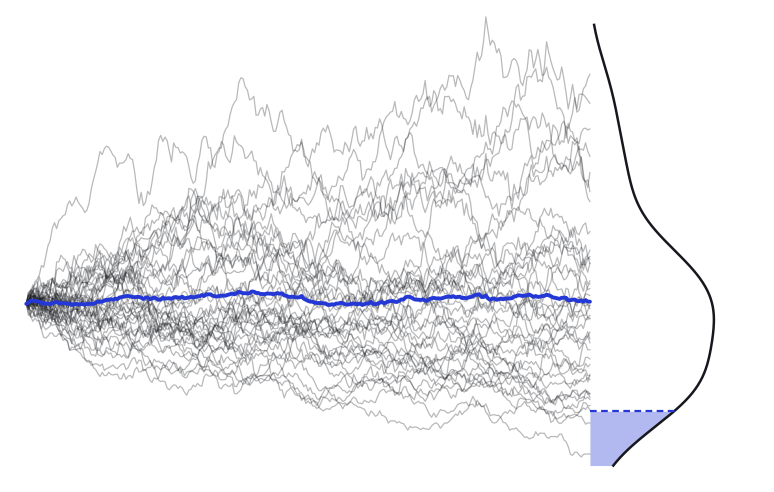
His doctoral research focused on developing new algorithms for sampling dense polymer systems, which are notoriously difficult to simulate with conventional methods such as Monte Carlo. These techniques drew both on strategies from statistical mechanics and on ideas borrowed from quantum computing. Part of his research also involved studying the topological properties of such systems, in particular the knotting and linking of polymer rings and the equilibrium properties of self-assembling chains.
After his PhD, Francesco spent a year teaching mathematics and physics to high-school students in Belluno, before joining d-fine in Milan as a consultant, where he now applies his knowledge in statistics in finance.
Francesco enjoys tackling complex problems from different angles, combining mathematics, programming, and statistics.
02 News
03 Education & jobs
Quantitative consulting
Teaching physics and maths to secondary students. I enjoyed writing exercises and preparing lab experiments, always trying to make the material accessible but engaging.
I worked on the development of advanced Monte Carlo methods and alternative sampling techniques based on quantum annealers for self-assembling polymers, under the supervision of Cristian Micheletti.
04 Publications
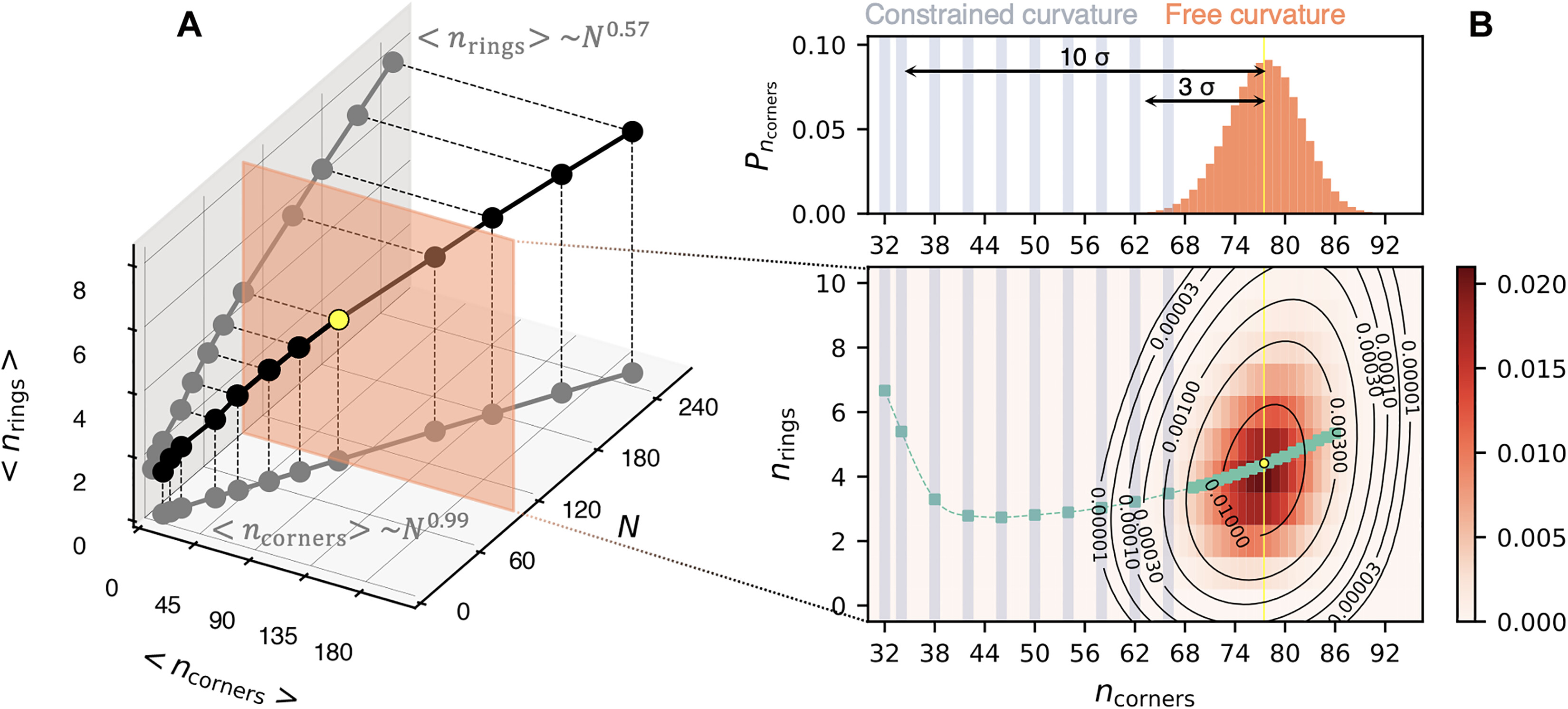
The quadratic unconstrained binary optimization (QUBO) encoding makes it possible to sample classical many-body systems that are otherwise intractable for conventional Monte Carlo, specifically self-assembled melts of rigid lattice ring polymers, where high density, chain stiffness and topological constraints drive real-space autocorrelation times to diverge.
Our quantum-inspired encoding overcomes this problem and enables sampling melts of lattice rings with fixed curvature and compactness, unveiling counterintuitive topological effects. Tackling the same problems with the D-Wave quantum annealer leads to substantial performance improvements and advantageous scaling of sampling cost with the size of the self-assembled ring melts. DOI: 10.1126/sciadv.adi0204 ↗
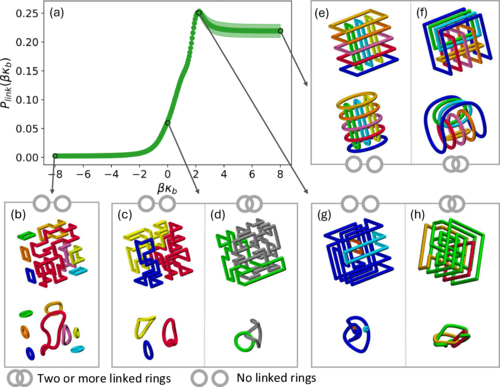
A general method for computing canonical averages of physical models sampled via quantum or classical quadratic unconstrained binary optimization (QUBO), built on a histogram-reweighting scheme applicable to QUBO-based sampling restricted to specific intervals of an order parameter such as physical energy.
The scheme accurately recovers the density of states, in turn allowing expectation values to be computed in the conjugate ensemble (e.g. at fixed temperature) for systems otherwise intractable with real-space sampling. Applied to space-filling melts of lattice ring polymers mapped in QUBO form, the method reveals that the ring catenation probability is nonmonotonic with bending rigidity. DOI: 10.1103/PhysRevResearch.7.023116 ↗
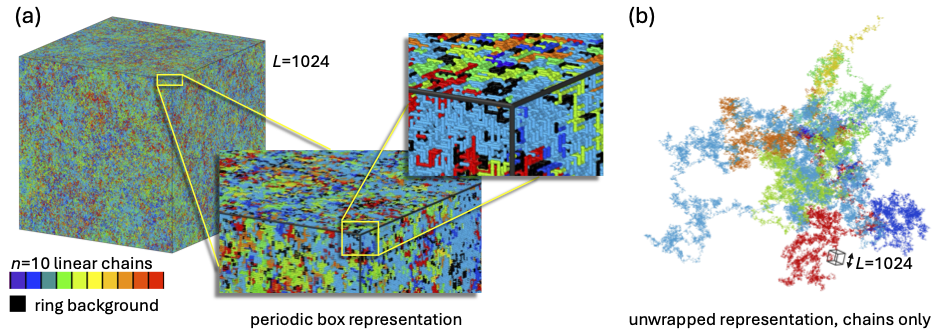
A Monte Carlo method for studying topological entanglements in polymer melts, overcoming the computational limitations associated with equilibrium sampling of long polymer chains. The approach exploits a self-assembly ensemble and strictly local moves to efficiently propagate backbone reconnections across scales while preserving the number of linear chains, achieving near-linear scaling of the decorrelation time with system size.
Applied to fully-packed lattice melts, the method enables the equilibration of systems containing more than one billion monomers and provides access to the universal melt regime. The characterization of intra- and inter-chain entanglements reveals that they arise from localized knots and links rather than global tangles, with the Gauss linking integral between neighbouring chains growing only as N1/4. DOI: 10.1038/s41467-026-74480-4 ↗
Full list on Google Scholar ↗ · ORCID ↗
05 What I work on
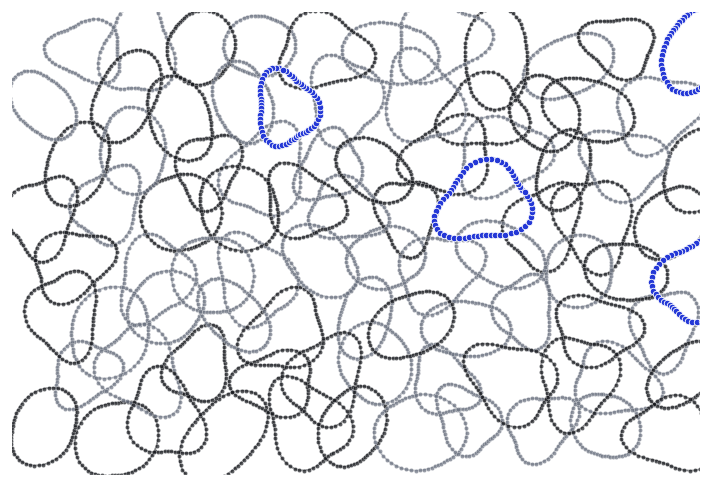
I am interested in the dynamic and equilibrium properties of melts of linear chains and rings. In particular, I look at the self and mutual entanglement of the components: the knotting probability of a single chain and the linking probability of multiple chains.
I am interested in developing new techniques for improving the sampling of physical problems, both by working on new Monte Carlo moves and by applying statistical mechanics ideas to the sampled configurations, to extract as much information as we can.
I have worked on alternatives to sampling algorithms, exploring in which cases optimization can be used in place of Monte Carlo. Among the several possibilities, I have looked at classical techniques, from in-house algorithms such as simulated annealing to commercially available solvers like Gurobi and CPLEX. I have also worked on quantum annealers, looking for use cases where they can offer a speed-up over classical techniques.
More recently I have become interested in quantitative finance, delving into the topic with the tools I developed during my career in physics.
06 My little projects
I cannot go into too much detail, but here is an overview of what I have worked on.
I worked briefly on the code for a data-scraping bot. In particular, I worked on the messaging layer between the orchestrator and the server, and implemented unit tests to verify that messages were correctly delivered and received.
I worked with Murex, a trading management software platform.
I wrote this site from scratch, as a single HTML file, mostly as an excuse to properly learn HTML, CSS, and JavaScript. It was also my first end-to-end deployment project outside of research: registering a domain, learning the difference between an apex and a www domain, putting Cloudflare in front of GitHub Pages for DNS, proxying, and HTTPS certificates, and finally making it actually findable online with a sitemap, a robots.txt file, and Google Search Console verification. None of that was obvious to me going in, so the site doubles as a learning log as much as a portfolio.
Material that I developed while teaching at the high school.
08 Personal life
From here on, this is the personal side: passions, hobbies, and behind the scenes.
09 Off the clock
Faction: Black Templars
Someday I will paint my miniatures and upload photos of how they turned out :D
Human Echo Knight
Volker is my first D&D character, and despite having played for more than three years, he is still going strong. Inspired by the low-magic—and low-gold of Wesnoth, Volker is a neutral good human fighter using Llaserlama’s fighter class. He is stupid, impulsive, and eager to fight, but also loyal, protective of his companions, and never afraid to throw himself into the middle of a battle, swinging his sword left and right. One small detail: he loves bear traps and trebuchets. As my first character, I did not have a clear idea of where I wanted to take him, and this is reflected both in his role within the party and in the way I built him. At first, I wanted to focus on the Gift of the Chromatic Dragon feat, as it provided an excellent hook for a narrative plot. For the same reason, I chose the Echo Knight subclass, since I thought it would be cool to connect both the flaming sword granted by the feat and the echoes to draconic power. In hindsight, I probably would have chosen Samurai instead. That would have allowed me to focus more on developing a relationship with the sword, rather than giving Volker several different powers. However, as time went on, Volker established himself as the party’s tank: the one who stays in front of the enemies, cuts down weaker foes, and keeps the boss occupied in a pit fight.
Gnomish Trickery Cleric
Gimble was my character for a campaign with several new players. We were going to play Phandelver and Below, and I was expected to be the most experienced player at the table. The party desperately needed a healer (despite already having a druid :|) so Gimble, a gnome cleric, joined the group. Gimble had been left behind by his original party. When he later tried to set out on an adventure by himself, he failed and began to believe that he was useless. I felt that this backstory matched the Trickery Domain perfectly, while also allowing me to play an experienced utility character for a group of beginners. Gimble supports the team with healing, buffs, and spells that many new players might overlook because they do not deal damage or look particularly impressive. At the same time, I was able to focus on creating a psychologically complex character and experiment with creative uses of illusions. Unfortunately, the campaign was cancelled, so Gimble will never achieve the redemption he was looking for.
Human Wizard
Konrad is the last character I created, and I made him for my first 3.5e campaign. When I joined the campaign, the other players told me, “We need someone with arcane knowledge, so either a wizard or a sorcerer.” I had my doubts, but eventually decided to play a wizard, as everyone knows that wizards in 3.5e are beasts. And so Konrad was born: a human wizard. Still quite young, Konrad is a specialist in magical artifacts who decided to become an adventurer in order to restore honor to his family name after incorrectly evaluating a magical artifact. Konrad is not violent. He seeks knowledge, is usually calm, and prefers to solve problems through magic rather than force. For this reason, I decided to specialize him as a control mage, using his spells to support his companions by disabling and debuffing opponents. This works particularly well with the rest of the party, which is almost entirely focused on dealing damage.
Coming soon.
10 Behind the scenes
11 Guestbook
12 Problem of the month
13 Found a bug?
Something broken or out of place? Tell me; it helps me fix it.
Prefer GitHub? Open an issue ↗